4 December 2025
Bali vs Dubai vs Gold Coast Property ROI: Real Numbers for 2026
I own investment properties in both Bali and Dubai. Here is the real 2026 ROI comparison covering yields, legal structures and which market actually wins.
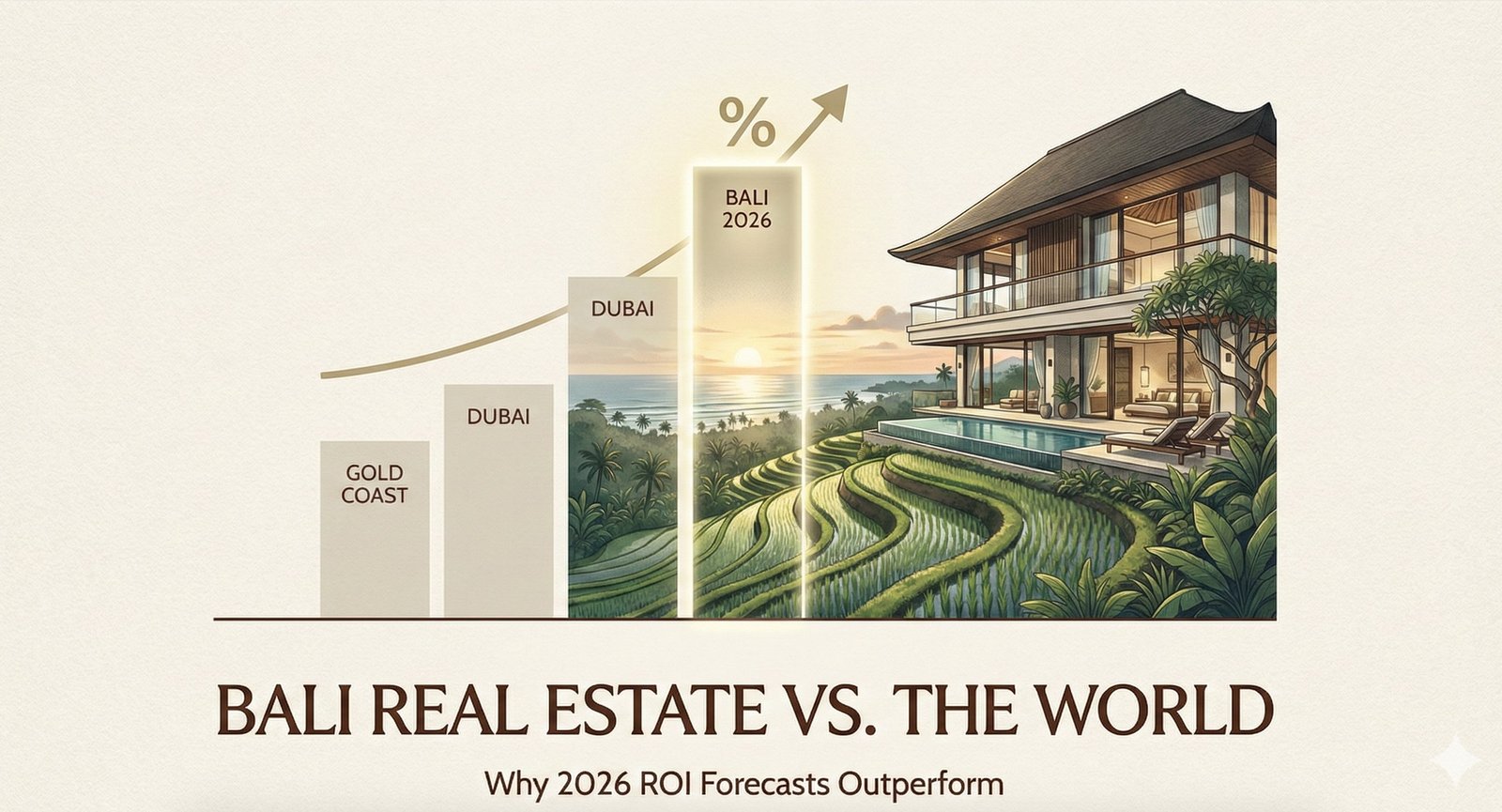
Everyone is talking about Bali right now. If you are looking to invest, you probably don’t want the fluff about sunsets and coconuts. You want to know if the numbers actually stack up. I am not going to drop a bunch of stats and run away. I want to explain precisely why Bali is still the king of real estate ROI and why it looks set to stay that way for the foreseeable future.
Key Takeaways
- ✓Bali outperforms both markets: The author personally earns 12% net in Bali vs 8% net in Dubai — the same capital generates 50% more income.
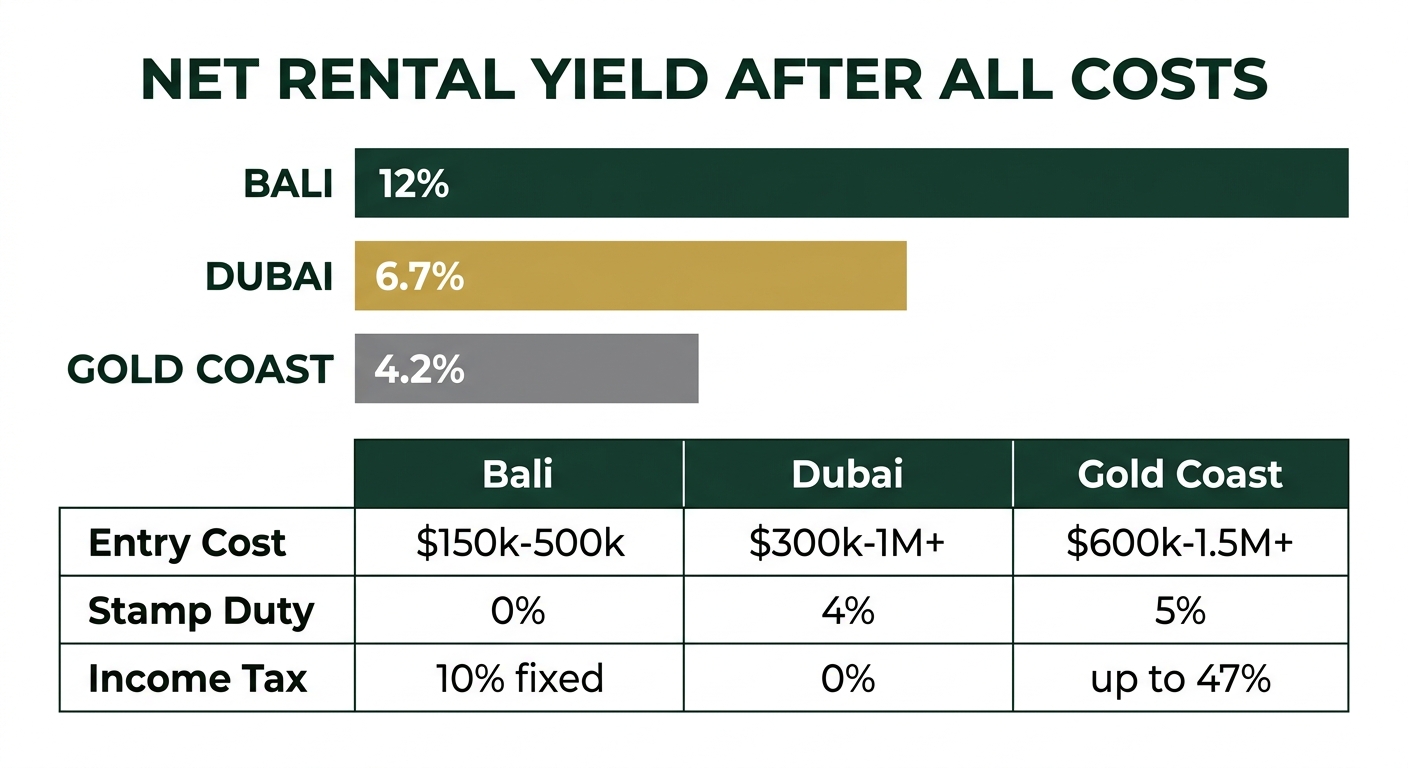
- ✓Net yields after all costs: Bali 10–14%, Dubai 6–7%, Gold Coast 3.5–5.5%. Gold Coast marginal income tax can shrink a 5% gross yield to 2.5–3% net.
- ✓Lower entry, higher upside: A fully-managed Bali villa costs what a single-bedroom Gold Coast apartment costs, at three times the yield.
- ✓USD-denominated income: Bali rents are quoted and paid in USD, not IDR. Currency risk is largely irrelevant to your returns.
- ✓No Airbnb restrictions: Bali operates freely. Dubai, Australia, and Europe are all tightening short-term rental regulation.
My own portfolio: Dubai vs. Bali
I don’t just advise clients on this. I put my own money into these markets. I currently own investment properties in both Dubai and Bali, so I can give you a direct comparison based on what hits my bank account every month. My Dubai investment is a solid 2-bedroom apartment. It is a stable asset and has definitely benefited from capital appreciation over the last few years. However, when I look at the cash flow, it usually sits around 8% ROI, after all fees and taxes. My Bali apartment is a different story. Right now, that property is sitting comfortably around 12%, net. That is a significant gap. 4% might not sound like much on paper, but compounded over years, it changes the entire trajectory of an investment portfolio.
The Data
You don’t have to take my anecdotal advice as gospel. If you look at the latest projected stats for 2026, the trend is visible across the board.
Sources: Neginski Real Estate 2025 Market Report, Global Property Guide and Property Finder 2025 Data. The logic here is straightforward. You are paying significantly less to enter the Bali market while generating a higher monthly return.
The Legal Edge: Why Bali is Actually Easier for Foreigners
If you haven’t spent time here recently, why is the demand so relentless? Many investors assume that because you can’t buy “Freehold” land in your personal name, Bali is complicated. The reality is the opposite. Indonesia has structured its property laws to make foreign investment seamless, provided you follow the right path. Compare this to other popular markets:
- Thailand: To buy a villa, you often need to set up a company where 51% of the shares are owned by locals (a risky nominee structure) or settle for buying a condo unit. You rarely have 100% control of the land.
- The Philippines: Foreigners are generally banned from owning land entirely, limiting you to condominium units only.
- Bali (Indonesia): You have two perfectly legal, 100% foreign-controlled options that require zero local nominees. I have been living here for two years now. I moved from the UK to Dubai, and finally to Bali. I have seen what those other hubs have to offer, and I don’t plan on leaving Indonesia anytime soon. The lifestyle here is the engine driving these property prices. The weather is elite. We get 30 degrees almost year-round. Even the rainy season towards Christmas is manageable. It is hard to beat that kind of consistency. The “Life Admin” factor. This is something people rarely talk about, but it is enormous. Think about how much of your week is consumed by washing dishes, doing laundry, or cleaning the house. In Bali, you have staff who happily take care of all of that for you. When you remove those tasks entirely, you get hours of your life back. That creates time for work, working out, or just relaxing. You have more time here. The community and wellness. The gyms in Bali are world-class. Seriously, they are some of the best facilities I have ever seen. This attracts a specific crowd. We have a fantastic community of nomads, entrepreneurs, and health-focused people who are all trying to improve their lives. Being around that energy is contagious. The unique food scene. The food in Bali is fantastic, but it occupies a particular niche. It caters to people who live here for months at a time and have no desire to cook. While you might not find the sheer density of Michelin stars you get in London, the mid-level food is unmatched. It is healthy, plentiful, and affordable. You can eat incredible meals three times a day for a fraction of the cost of living in the US or Europe. It is genuinely livable. This isn’t just a holiday island anymore. We have great shopping, boutique cinemas, and activities ranging from paintball to pottery to dirt biking. It is a fully functioning society that costs much less than Dubai or Australia while maintaining a high quality of life. Plus, you have the nicest local population in the world and cute dogs running around the streets. Who doesn’t love that?
Entry Costs & Total Investment Compared
One thing the headline yield numbers don’t capture is how much it costs to get into each market. When you factor in stamp duty, legal fees, and agent commissions, the gap between Bali and Western markets gets even wider.
| Market | Typical Entry Cost | Buyer’s Stamp Duty | Legal / Agent Fees |
|---|---|---|---|
| Bali | $150k–$500k | None | ~2–3% (notary + agent) |
| Dubai | $300k–$1M+ | 4% DLD fee | ~2–4% |
| Gold Coast | $600k–$1.5M+ | 3–5% stamp duty | ~2–3% |
Bali wins on entry cost at every tier. You can own a fully managed, income-producing villa in Bali for what a one-bedroom Gold Coast apartment costs, while generating triple the yield.
The Gold Coast Reality Check
The Gold Coast is often cited as a high-yield Australian alternative. And to be fair, the Surfers Paradise and Broadbeach markets do generate above-average Australian rental income. But “above average Australian” is not the same as competitive.
Short-term rental regulations in Queensland have tightened significantly. Council restrictions, body corporate rules, and the introduction of licensing requirements for Airbnb properties have introduced friction that simply doesn’t exist in Bali. Property taxes, land taxes, and capital gains tax eat further into returns.
Net yields on Gold Coast investment properties typically land between 3.5% and 5.5% after costs. Compare that to Bali’s 10–14% net and the conversation becomes short. If you want to see what those Bali numbers look like on your budget, run them through our free Bali ROI calculator.
Currency & Exchange Rate Considerations
One question investors always ask: what happens if the Indonesian Rupiah weakens?
The good news is that Bali’s rental market is almost entirely USD-denominated. Developers price in USD, short-term rental platforms charge guests in USD or their home currency, and management companies pay out in USD. The IDR is largely irrelevant to your returns unless you’re converting large amounts back to a home currency at an unfavourable time.
This is actually an advantage over the Gold Coast, where your rental income, property value, and eventual sale proceeds are all in AUD, fully exposed to currency fluctuation relative to your home currency.
Airbnb Restrictions: A Growing Risk in Western Markets
Bali remains one of the few major tourism destinations where short-term rental platforms operate without meaningful government restriction. Compare this to:
- Dubai: Short-term rental permits required, subject to DTCM regulation and periodic tightening
- Gold Coast / Australia: State-by-state regulation, with growing moves to cap short-term rentals in tourist precincts
- Europe: Cities like Barcelona, Amsterdam, and Paris have effectively banned or severely restricted Airbnb
Bali’s government has actively encouraged villa tourism as a key economic pillar. That structural support underpins the rental market in a way that Western markets simply cannot offer.
The Bottom Line on Fees and Running Costs
Gross yield comparisons look great on paper. Net yield is what lands in your account. Here is a realistic annual cost breakdown across the three markets for a comparable investment property:
| Cost | Bali | Dubai | Gold Coast |
|---|---|---|---|
| Management fee | 15–20% of revenue | 10–15% of revenue | 8–12% of revenue |
| Annual land/property tax | Minimal (~$50–200) | 0% (no property tax) | Land tax applies above threshold |
| Income tax on rental | 10% final withholding | 0% (free zone) | Up to 47% marginal |
| Maintenance reserve | 2–3% of value/year | 1–2% of value/year | 1–2% of value/year |
| Insurance | ~$500–1,000/year | ~$1,500–2,500/year | ~$2,000–4,000/year |
The Gold Coast column is where the real damage occurs. Once Australian marginal income tax rates are applied to rental income, a nominal 5% gross yield can shrink to 2.5–3% net for a higher-rate taxpayer. Bali’s 10% final withholding is fixed and predictable. If your home country has a DTA with Indonesia, it is often creditable against your domestic liability.
The Verdict
These are the reasons Bali has stayed at number one. The lifestyle is unmatched, and that keeps occupancy rates high. The real estate market is just a reflection of that demand. If you are waiting for the “bubble” to burst, you might be waiting a long time. The fundamentals are too strong.
Ready to improve your ROI?
If you are tired of standard 4% returns and are ready to make your capital work harder, we should chat. We know the market, we know the numbers, and we know how to navigate Bali safely. If you are interested and ready to invest, talk to us.
Convinced Bali is the right market? Explore our location guides: invest in Canggu for the highest-volume market, or invest in Uluwatu for luxury clifftop villas. And if you’re new to Indonesian property law, our foreigners buying guide covers everything you need to know.
Considering investing in Bali? Let's talk. Book a no-obligation call.