4 December 2025
Case Study: How We Made $50k Profit in Under 6 Months For a Client (And The Exact Strategy We Used)
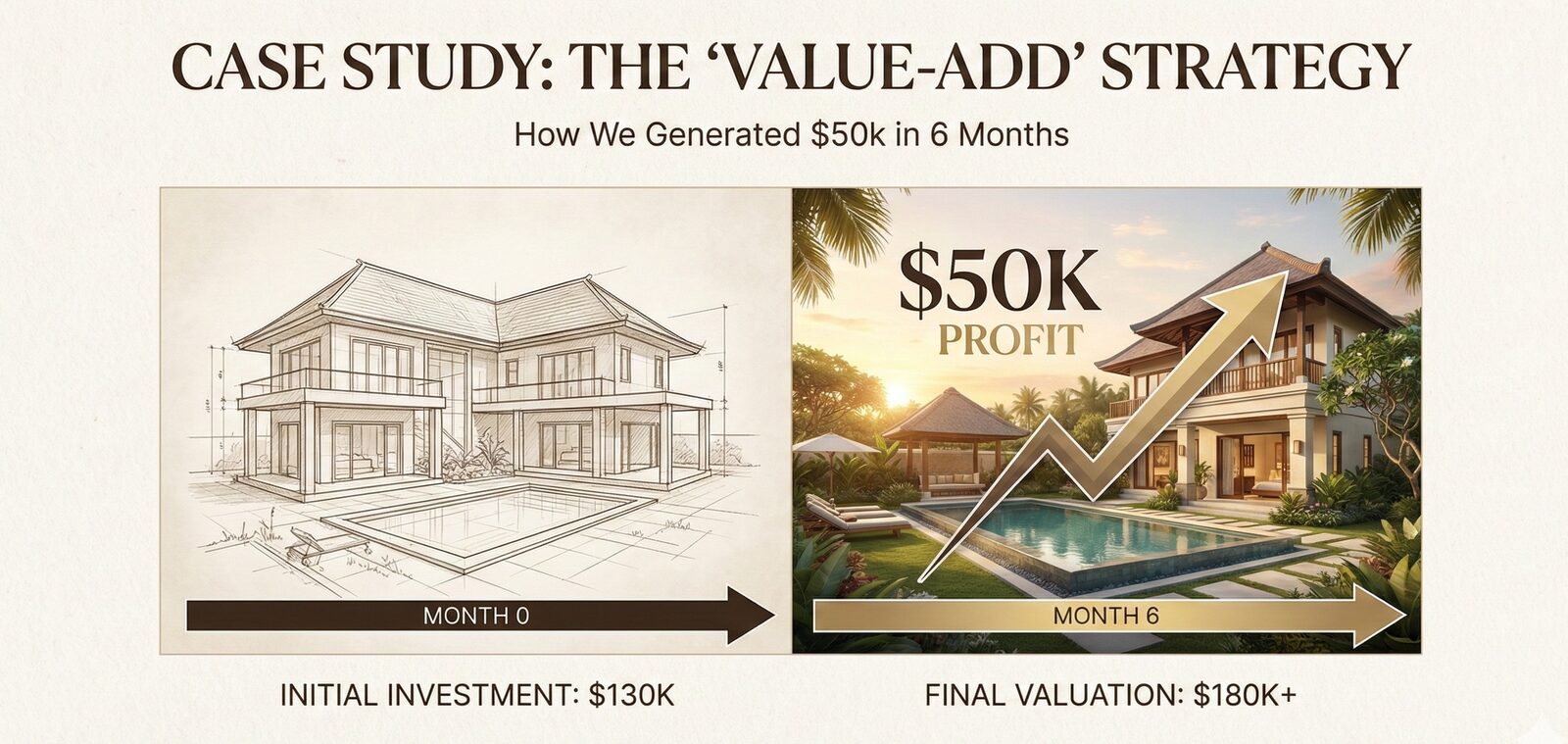
We negotiated a villa from $163k to $130k, secured 15% net ROI, and added $50k equity before completion. All in under six months. Here is the exact strategy.
I love it when a client knows exactly what they want.
Recently, a couple came to me with an obvious scenario: “We live in Spain, we have just sold our apartment in Belgium, and we want to invest that capital into Bali. We have no intention of ever living there; we want rental income. Capital appreciation would be a bonus. Oh, and by the way, we don’t want to lift a finger when it comes to management.”
To me, this translated to a particular checklist:
- Budget: Around $150k.
- Type: Turnkey solution (likely off-plan).
- Goal: Pure ROI. The location didn’t need to be “emotionally” right for them; it just needed to be profitable for tourists.
- Management: 100% hands-off.
Here is how we turned that brief into a massive win.
Key Takeaways
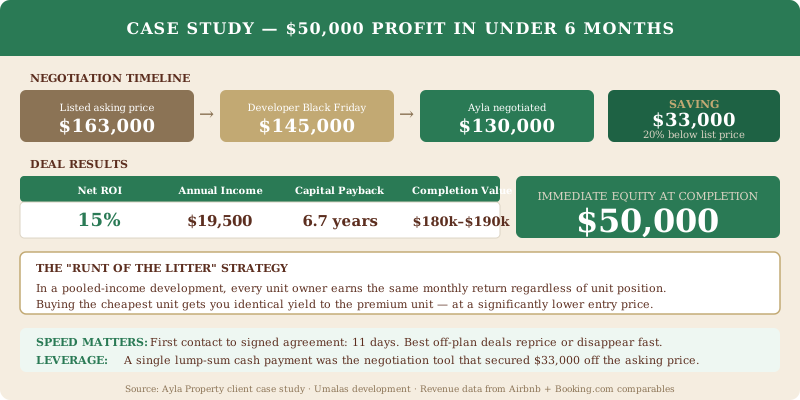
- ✓Negotiated 20% below list price: $163,000 listed → $130,000 secured. A single lump-sum cash payment created the leverage. $33,000 saved before the investment even started.
- ✓The "runt of the litter" strategy: Pooled income development means every owner earns the same regardless of unit position. Buy the cheapest unit, earn the same yield as the most expensive.
- ✓$50,000 equity at completion: Property worth $180k–$190k at handover on a $130k purchase. Capital returned + $50k gain before a single guest checked in.
- ✓15% net ROI projected: ~$19,500/year. Capital payback period of 6.7 years. Everything after that is profit with the asset still generating income.
- ✓Speed matters: First contact to signed agreement in 11 days. The best off-plan deals reprice or disappear fast. Analysis paralysis is expensive in this market.
The “Uber Spreadsheet”
Here at Ayla, we pride ourselves on our data. We don’t just guess; we track everything. We have an “Uber spreadsheet” containing information on almost every credible developer in Bali and every active project.
We started filtering. We looked for a minimum 28-year leaseholds (to maximise ROI runway) and filtered the market down to 6 specific developments that fit the criteria.
From those 6, we compared them head-to-head. We looked at potential rent, land size, build quality, and, crucially, developer reputation.
We eventually cut that list down to 3 strong contenders. Then, we went to work.
Going to War
Once we picked the target, we went to war for our clients.
I am not going to divulge our exact negotiation tactics (trade secrets, after all), but here is the deal we structured.
The apartment was listed originally at $163,000 USD. The developer had a Black Friday offer running, bringing it down to $145,000.
Most agents would have stopped there. We didn’t. Based on the promise of one single cash payment from the clients, we managed to haggle the price down to $130,000.
Even we were impressed with ourselves on that one.
The “Runt of the Litter” Strategy
Now, here is the secret sauce. The unit we bought was technically the “runt of the litter.”
It was relatively the “worst” positioned unit in a pool of 6 apartments being built in Umalas. If you were buying a home to live in, this might be a negative. But if you are investing? It was a stroke of genius.
Why? Because of the management structure.
In this specific development, the rental income is pooled. The revenue from all 6 apartments is totalled and divided equally among the owners. It doesn’t matter whether your unit has a slightly better view; you still get the same check at the end of the month.
By buying the cheapest unit (the “runt”) for $130k, our clients get the same return as the guys who paid full price for the “best” unit.
The Result
The numbers speak for themselves.
Based on conservative estimates, the rental ROI for this place, after all management fees and taxes, will sit around 15%.
But the real win is the equity. As soon as the apartment is completed and ready to live in (scheduled for this April), the market value will sit between $180,000 and $190,000.
Because we bought well and negotiated hard, our clients are sitting on an immediate $50,000 profit if they choose to flip it the day they get the keys.
Not bad, eh?
The Due Diligence Process
Once we identified the target development, we didn’t just hand over the details to our clients and wish them luck. We ran a complete due diligence check before recommending they proceed.
This covered four areas:
Developer verification. We checked the company registration, looked at their previous completed projects, spoke to past buyers, and verified their financial standing. This developer had two previous completions in the Canggu corridor. Both delivered on time and both generating the projected rental returns. That track record mattered.
Title and zoning. Our notary partner ran a full title check on the land parcel, confirming clean ownership and no encumbrances. The zoning was confirmed for villa and commercial rental use. Building permits (IMB) had been applied for correctly. This step alone eliminates the majority of Bali property horror stories.
Rental comparables. We pulled actual Airbnb and Booking.com data for comparable units within 500 metres. Occupancy rates averaged 74% across comparable listings over the prior 12 months, with average daily rates that supported the 15% net yield projection. We were comfortable recommending based on hard data, not developer projections.
Contract review. Our legal team reviewed the PPJB (sale and purchase agreement) before our clients signed. The lease term, renewal clause, payment milestones, and penalty provisions were all checked and negotiated where needed.
Setting Up the Management
Our clients were in Spain. They had no intention of visiting Bali before or after the purchase, which is completely normal and fully supported by how the Bali property market works.
Within two weeks of the agreement being signed, we had introduced them to our preferred property management partner for the Umalas area. The management agreement was signed remotely, with an agreed fee structure of 20% of gross rental revenue covering: all booking platform management, housekeeping, guest communication, maintenance coordination, and monthly reporting.
The villa was listed on Airbnb and Booking.com before construction was even complete, building up reviews from early guests during the soft-launch phase. By handover, they already had a booking history.
Lessons From This Deal
Every deal teaches us something. A few takeaways from this one:
Pooled income structures are underappreciated. Most investors fixate on finding the “best” unit in a development. The pooled income model flips that logic entirely. Not enough investors know to look for it.
Negotiation leverage is highest at off-plan stage. Once a development is completed, the developer’s cash pressure is gone. At the off-plan stage, especially when offering a single lump-sum payment, you have genuine leverage. We got $33,000 off the asking price. That is not typical, but it is possible when you know how to negotiate and what the developer actually needs.
Speed matters. The developers who offer genuinely good terms don’t leave those terms on the table for long. Our clients moved from first introduction to signed agreement in 11 days. Investors who spend months deliberating often find the deal is gone, or repriced upwards.
What This Deal Looked Like on Paper
For those who want the numbers summarised cleanly:
| Metric | Value |
|---|---|
| Listed price | $163,000 |
| Developer offer | $145,000 |
| Ayla negotiated price | $130,000 |
| Saving vs. list | $33,000 (20%) |
| Projected net ROI | 15% |
| Projected annual income | ~$19,500 |
| Capital payback period | ~6.7 years |
| Estimated completion value | $180,000–$190,000 |
| Immediate equity on completion | ~$50,000 |
The payback period is particularly important. When a property returns your full initial investment within 7 years, everything after that is pure profit, and you still own the asset with years of lease remaining. You can model payback periods like this for any budget with our free Bali ROI calculator.
Who This Strategy Works For
The pooled-income, runt-of-the-litter approach is not right for every investor. It works best for:
Pure income investors who don’t need the prestige of the “best” unit and care only about the return on their money. The view from your unit does not change what lands in your bank account each month.
First-time Bali investors who want a lower entry point without sacrificing yield. At $130,000, this deal was accessible to buyers who couldn’t stretch to $300,000+ for a standalone villa, while still generating a 15% net return.
Hands-off investors who need everything managed. The pooled management model means a professional team handles the property regardless of your unit’s individual position in the building. There is no “bad draw” in terms of management quality.
It is not ideal for investors who want a trophy property they can use personally for extended stays, or for buyers whose primary goal is capital appreciation on a unique asset. For them, a standalone villa in a prime location makes more sense. Both approaches have their place. We can model both for you.
Ready to invest?
If you want us to find you a deal like that, or if you want access to our “Uber spreadsheet,” get in touch.
We know where the value is hiding in this market. If you are interested and ready to invest, talk to us.
The villa in this case study was located in the Canggu corridor. Read our full Canggu investment guide to understand why it remains Bali’s most in-demand market, and our foreigners buying guide to understand the legal process step by step.
Considering investing in Bali? Let's talk. Book a no-obligation call.