4 December 2025
The Freehold Trap: Why Smart Foreign Investors Actually Prefer Leasehold for Higher ROI
Most foreign investors demand freehold. In Bali, that is a mistake. Discover why leasehold delivers higher ROI and how smart investors use it.
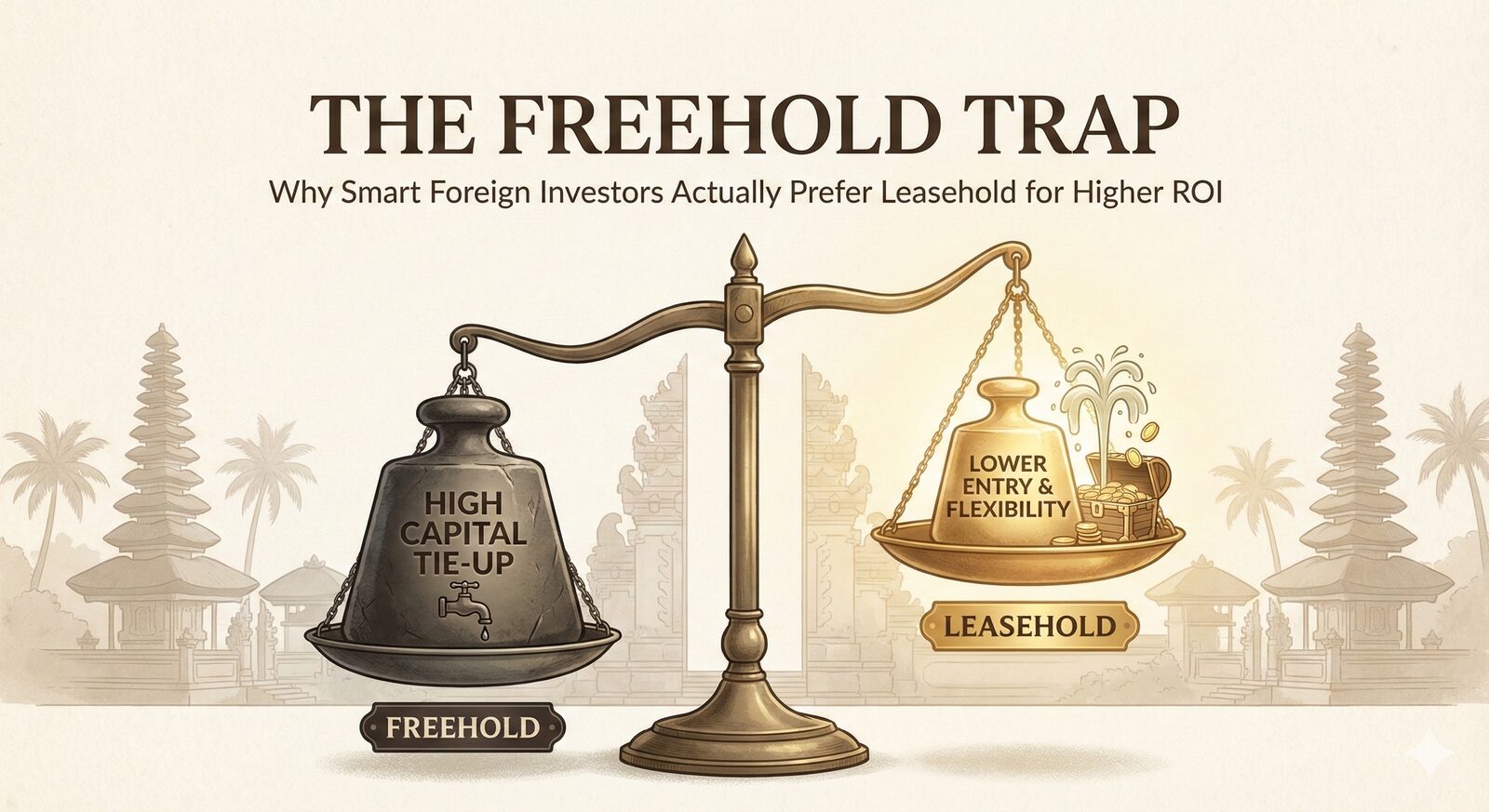
When most people start looking at real estate in Bali, their first instinct is: “I want Freehold.”
It makes sense. In Europe, Australia, or the US, owning the land forever is the gold standard. Why would you “rent” land for 25 or 30 years when you could own it outright?
But here is the truth that many new investors miss: In Bali, “Forever” is expensive.
While you can buy Freehold (Hak Milik) in Bali, usually through a PT PMA company, it comes with a massive premium. And if your goal is pure Return on Investment (ROI), that premium can actually be a trap. Not sure which title you are eligible for? Our free ownership checker answers that in about thirty seconds.
Here is why the smartest money in Bali is often flowing into Leasehold.
Key Takeaways
- ✓Freehold costs 2–3x more for identical rental income: $500k freehold = 8% ROI. $200k leasehold on the same street = 20% ROI. The Airbnb guest pays the same rate regardless of your title.
- ✓Bali's hot spots shift fast: Leasehold gives you the agility to enter a high-growth area, ride the appreciation wave for 5–7 years, and exit before the "cool factor" fades. Freehold marries you to a postcode.
- ✓The tropical climate reality: Intense sun, humidity, monsoon rains mean villas need major renovation every 15–20 years. Paying a freehold premium to own a structure that will need gutting is poor capital allocation.
- ✓The flip and roll strategy works: Buy off-plan leasehold → 15–20% ROI for 3–5 years → sell at appreciated value → reinvest in the next emerging area. Compound your gains every cycle.
- ✓A good lease must have: BPN registration, locked renewal pricing, a fixed 25+25 term structure (not rolling), and explicit right to sell without landowner approval.
1. The ROI Math (Lower Entry, Higher Yield)
You can model every scenario below on your own numbers with our free Bali ROI calculator.
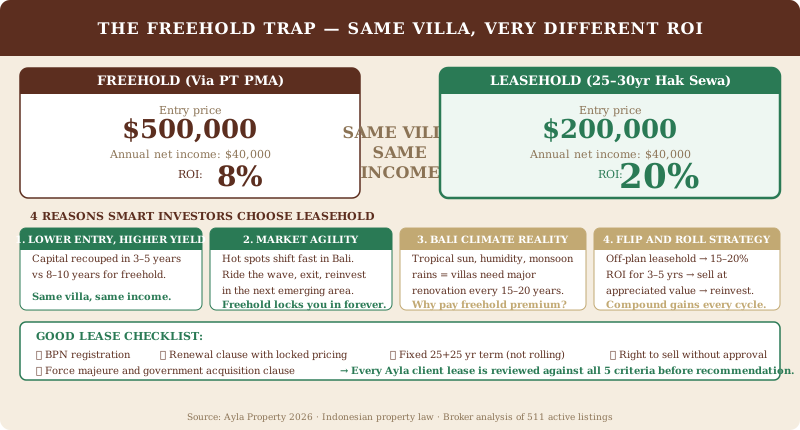
The math is simple. A Freehold property in a prime area like Pererenan might cost you double or triple the price of a Leasehold property on the exact same street.
However, the rental income you generate is precisely the same. A tourist on Airbnb doesn’t care if you own the land forever or for 25 years; they pay the same nightly rate.
- Scenario A (Freehold): You pay $500k. You net $40k/year. ROI = 8%.
- Scenario B (Leasehold): You pay $200k. You net $40k/year. ROI = 20%.
By insisting on Freehold, you are often killing your cash flow efficiency. Leasehold allows you to enter the market with less capital and recoup your initial investment much faster, often in 3 to 5 years.
2. The “Moving Target” Market
The landscape of Bali changes fast. It is booming, and the “hot spots” shift rapidly.
Ten years ago, nobody was investing in Canggu. Five years ago, nobody was looking at Seseh. High-yield areas right now might not be the “place to be” in 10 or 15 years.
Freehold marries you to a location forever. Leasehold gives you agility. The strategy for many savvy investors is to enter a high-growth area, ride the wave of popularity for 5-7 years, and then exit. You aren’t tied down to a location that might lose its “cool factor” in a decade.
3. The “Bali Weather” Reality
This is the point nobody talks about until they live here.
Bali has a brutal climate for buildings. The combination of intense tropical sun, high humidity, salt air, and heavy monsoon rains means that buildings degrade much faster here than in the West.
A villa in Bali generally requires a massive makeover, or even a full rebuild, every 15 to 20 years.
So, ask yourself: Why are you paying a premium to own the land forever when the asset sitting on it (the villa) will need to be gutted in 15 years?
4. The “Flip and Roll” Strategy
Because demand in Bali is growing each year, the “Buy and Flip” method remains one of the best strategies available.
The play works like this:
- Buy a Leasehold off-plan at a reasonable price.
- Enjoy 15-20% ROI for 3-5 years.
- Enjoy capital appreciation as land values in the area spike.
- Sell the remaining lease.
Even with fewer years left on the lease, the rise in daily land prices often means you can sell for a profit. You then take that capital and roll it into the next emerging area (like Kedungu or the West).
What a Good Lease Agreement Actually Looks Like
Not all leasehold agreements are equal. The quality of the lease document itself is one of the most important factors determining how secure and how valuable your investment is. Here is what to look for and insist on:
Registered with BPN (National Land Agency). A notarised lease that is not registered with BPN has significantly weaker legal standing. Always ensure your PPJB or lease deed is submitted for BPN registration. This is non-negotiable.
Clear renewal clause. The renewal right should be explicitly stated in the contract, not implied or subject to future negotiation. Ideally, the renewal price or pricing formula (e.g. 10% above the original land value per year of the new term) is locked in at the time of the initial purchase.
Fixed term, not rolling. A 25+25 year structure with a defined right of renewal is far stronger than a rolling lease that requires annual renewal. Rolling structures give the landowner leverage at every renewal point.
Transferability. You need the explicit right to sell, sublet, or transfer the lease to a third party without requiring the landowner’s approval (or with approval not to be unreasonably withheld). This is what gives you an exit.
Force majeure and government acquisition. Rare but worth having: protection clauses for scenarios where government compulsory acquisition occurs during your lease period. In this case, compensation should flow to you, not the landowner.
At Ayla, every lease our clients sign has been reviewed by our independent notary for all of the above points. We reject or renegotiate leases that don’t meet the standard before recommending a purchase.
When Freehold (PT PMA) Does Make Sense
It would be misleading to suggest leasehold is always the answer. There are specific scenarios where setting up a PT PMA and acquiring freehold title (Hak Guna Bangunan) is the right move:
You’re planning to hold the property for 30+ years. If this is a true forever investment, not something you intend to exit, the ongoing certainty of freehold and elimination of renewal risk may justify the higher entry cost.
You’re building a portfolio of multiple properties. A PT PMA becomes more cost-efficient as a vehicle when you’re buying more than one property. The setup cost is fixed, but the benefit scales.
You want to operate a formal hospitality business. If you’re planning to run a villa as a licensed boutique hotel or commercial accommodation business under Indonesian law, a PT PMA is generally required.
You plan to retire to Bali. The combination of freehold security and the ability to use the property as a personal residence indefinitely appeals to buyers who want more than just an investment.
The key is to match the structure to the objective. This is exactly the kind of conversation we have with every client in our first call.
How to Exit a Leasehold Investment
One of the most common questions: “How do I eventually sell a leasehold with fewer years remaining?”
The answer is that a well-documented, BPN-registered leasehold with a solid rental history sells well, often better than the buyer expects. Here is why:
The buyer you’re selling to is not buying a depleting asset. They are buying a proven, income-producing business. A villa with two years of Airbnb reviews, documented 75% occupancy, and a professional management contract attached is worth more per year of remaining lease than a brand-new, unproven villa with a full fresh lease.
Buyers in Bali’s maturing market are increasingly sophisticated. They can model the remaining lease income, subtract management costs, and arrive at a fair price for the remaining years. Many buyers specifically target mid-lease properties because they are cheaper to enter than off-plan while still carrying income proof.
The practical strategy: exit at year 7–10 of a 25-year lease, once the rental track record is established but while substantial lease life remains. This is consistently where the best seller returns are generated.
Common Leasehold Myths Debunked
Myth: “A leasehold property is worthless at the end of the lease.”
Reality: Your lease term should be structured to align with your investment horizon. If you are planning a 5–7 year hold, a 25-year lease starting today gives you 18–20 years of value remaining when you sell, more than enough to command a strong price. Very few investors hold Bali property for 25+ years in the current market.
Myth: “The landowner can refuse to renew.”
Reality: With a well-drafted lease, the renewal right is contractual, not a favour. The landowner cannot refuse if the renewal clause is properly structured, and the price formula is set at the time of the original purchase. This is why lease document quality matters so much, and why we insist on independent notary review for every Ayla client.
Myth: “Banks won’t finance leasehold.”
Reality: Indonesian banks won’t finance foreign buyers regardless of title type. That is not a leasehold issue. For overseas investors financing from their home country (using home equity or portfolio loans), the title type in Indonesia is largely irrelevant to the lender. They’re lending against your assets at home, not the Indonesian property.
Myth: “You can’t renovate or improve a leasehold property.”
Reality: As the lessee, you have full rights to build, renovate, and improve the property during your lease term. Any improvements typically belong to you during the lease, with reversion to the landowner at expiry. This is another reason the 5–7 year exit strategy makes sense.
The Verdict
Freehold has its place, usually for people who want a forever home to retire in.
But if you are an investor looking to maximise your capital, don’t get hung up on “owning it forever.” In a market as dynamic and tropical as Bali, Leasehold isn’t a compromise; it’s a financial tool that often outperforms the alternative.
Ready to run the numbers?
We can show you side-by-side comparisons of Freehold vs. Leasehold opportunities available right now, so you can see precisely how the ROI differs.
If you are interested and ready to invest, talk to us.
Ready to put leasehold strategy into practice? Browse our guides to invest in Canggu and invest in Uluwatu, or read our complete guide to buying property in Bali as a foreigner, including a full breakdown of lease structures and renewal terms.
Considering investing in Bali? Let's talk. Book a no-obligation call.