2 June 2026
Buying Property in Bali in 2026: What the Market Actually Looks Like Right Now
We analysed 511 active listings across 80 Bali developers. Here is what buying property in Bali actually looks like in 2026: prices, yields, process, and what to avoid.
I spend a lot of time listening to people describe the Bali property market based on what they read two years ago. The blogs talking about hidden gem prices and undiscovered yields. The forums with advice from investors who bought in 2019. The general sense that Bali is still a frontier market where you can pick up something amazing for $150,000 if you just know where to look.
Here is what the market actually looks like in 2026, drawn from 511 active listings across more than 80 developers that we track directly.
Key Takeaways
- ✓Median entry is $290,000: Based on 511 active listings across 80 developers. Quality stock in strong locations starts around $250,000. Premium Canggu and Seminyak starts at $380,000.
- ✓Average gross yield is 10.6%: Canggu tops at 14.8%. Compare to Australia (3–4%), UK (3–4%), Dubai (6–7%). Bali's yield premium is real and demand-led.
- ✓2026 is better than 2019 for certainty: Developers have track records. Notaries are established. You can underwrite a deal on real occupancy data before you commit.
- ✓3 deal-killers to avoid: Wrong zoning (agricultural land cannot be rented legally), missing PBG/SLF permits, and weak lease renewal terms.
- ✓2026 compliance is now enforced: All short-term rental listings require a valid NIB and KBLI 55203 classification. Platforms are actively delisting non-compliant properties.
The Current Market Snapshot
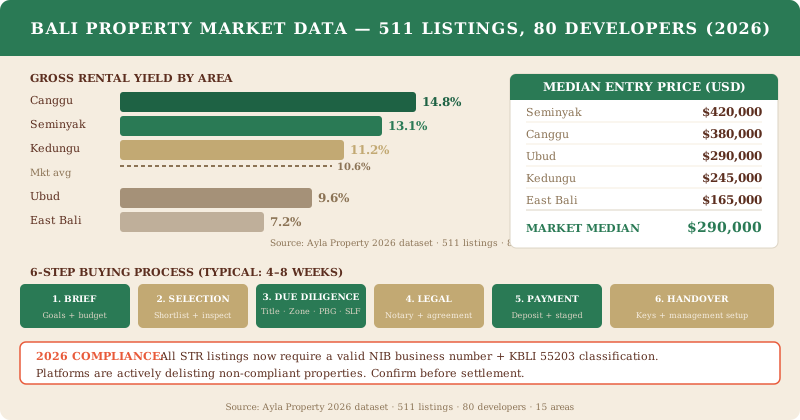
The median entry price across our active listings is $290,000. That is the midpoint of the market right now for a purchase-ready investment villa. Quality stock in strong locations starts around $250,000. Premium properties in Canggu and Seminyak sit at $400,000 to $600,000 and above.
Average gross yield across the market is 10.6%. That is meaningfully higher than most comparable markets globally: Australian residential yields are running at 3 to 4%, UK yields are similar, Dubai is at 6 to 7%, and Lisbon is down to 4 to 5%. Bali’s yield premium exists because the tourism demand that drives short-term rental income remains strong and the property prices have not yet fully caught up with that income potential.
The top end of the yield range is 15% or above in Canggu, Pererenan, and parts of East Bali where entry prices are still relatively contained. The average masks a significant spread between well-positioned properties and poorly managed ones.
Why 2026 Is Still a Reasonable Entry Point
I am not going to oversell this. The 2019 or 2020 window, when pre-construction prices were materially lower and the market had not yet been discovered by the volume of international capital it now sees, has closed. That opportunity is gone.
What exists in 2026 is a market that has matured past the speculation phase and is now producing real, measurable rental income with real transaction infrastructure. Developers have track records. Notaries and lawyers who understand foreign buyer transactions are well established. Property management companies have years of performance data. The ability to actually underwrite a deal before you buy, rather than hoping yields materialise, is now possible in a way it was not in 2018.
For investors who like certainty over speculation, 2026 is actually the better time to buy than 2019 was. You can verify what properties actually earn before you commit.
Price by Area
The market is not uniform and pretending it is will cost you money. Here is where things stand across the main areas in 2026:
| Area | Median Entry (USD) | Avg Gross Yield | Profile |
|---|---|---|---|
| Seminyak | $420,000 | 13.1% | Mature luxury market, premium guests, reliable cash flow |
| Canggu | $380,000 | 14.8% | Highest yield, strongest demand, digital nomad hub |
| Ubud | $290,000 | 9.6% | Cultural tourism, longer-stay guests, lower management intensity |
| Kedungu | $245,000 | 11.2% | Emerging west coast, most new developer launches in 2026 |
| East Bali | $165,000 | 7.2% | Lowest entry, diving and eco tourism, yield depends heavily on operator |
Source: Ayla Property 2026 dataset, 511 active listings across 80 developers and 15 areas. Yields are gross projections.
A few things worth knowing about this table (you can model any of these scenarios with our Bali ROI calculator). Canggu delivering 14.8% at a $380,000 entry is a function of extremely high short-term rental demand and year-round occupancy. Kedungu’s 11.2% is an early-adopter figure that reflects constrained supply, not developed rental infrastructure, so it is for investors who are comfortable with a 12 to 18 month ramp-up period. East Bali yields vary more than anywhere else on the island and depend heavily on the quality of the management operator.
The Buying Process in Plain Terms
The process has six steps and moves faster than most buyers expect once you are ready.
First is the brief: what are your yield requirements, hold period, budget, and preferred area? Getting this clear upfront saves significant time.
Second is selection: your broker presents shortlisted properties matched to that brief, you review, and you physically or virtually inspect the ones worth further consideration.
Third is due diligence: title search confirming clear ownership and no encumbrances, zone verification confirming tourism or residential use is permitted, PBG (building permit) check, SLF (Sertifikat Laik Fungsi / Certificate of Functional Eligibility) check confirming the structure is certified for occupancy and meets regulatory standards, and review of any existing management contracts.
Fourth is legal: a licensed PPAT notary prepares the lease agreement or sale agreement, your independent legal counsel reviews it, any required power of attorney is executed if you are buying remotely. For a complete legal breakdown of ownership structures, title types, and what to check in every agreement, read our comprehensive Foreigners Buying Guide.
Fifth is payment: typically a small deposit to hold the property during due diligence, then staged payments aligned to the agreed schedule. New builds use a different payment schedule tied to construction milestones.
Sixth is handover: keys, inventory, transfer of existing management arrangements, and introduction to the property management company.
End to end, for a ready-built property, the process typically takes 4 to 8 weeks from selection to handover.
The Three Things That Kill Deals
In three years of brokering in Bali, I have seen the same problems kill deals repeatedly.
Wrong zoning is the most common. A villa that looks perfect can sit on land zoned for agriculture or rice paddy preservation, making legal operation as a rental property impossible. Always check the zone map before you go further. This is not optional and it is not difficult. It just needs to be done.
Missing or irregular permits are the second killer. A property without a valid PBG (building permit, formerly IMB) or without an SLF certificate is operating outside regulatory compliance. The risk is a government order to cease operations, a requirement to demolish or rectify, or inability to obtain required licenses. In 2026, enforcement has been getting more consistent, not less. Do not buy a property that cannot show clean paperwork.
Weak lease terms are the third. A lease that does not include a clear renewal clause, or where the renewal is at the landowner’s discretion rather than the buyer’s right, is a significant risk at year 25. By the time you discover this problem it is too late. Get the lease reviewed by a competent lawyer before you sign.
The 2026 Regulatory Update
Two regulatory changes are affecting buyers in 2026 that were not in play two years ago.
First, properties operating as short-term rentals now require a valid NIB (business identification number) and must be classified under the correct KBLI business code. Properties that were operating informally under an owner’s personal arrangement are increasingly being required to formalise. If you are buying a rental-income property, confirm the NIB and KBLI classification is in place or can be obtained before settlement.
Second, KBLI licensing has become more specific about what business activities are permitted under which codes. Villa accommodation (KBLI 55203) is the relevant code for most short-term rental operations. Confirm your property’s operational license matches its actual use.
Both of these are navigable with the right legal team. They become expensive surprises if you do not check.
For a full breakdown of the developer landscape, our Bali Developer Report 2026 covers the 80-plus developers we track and what to look for when evaluating a new build. The Indonesia Foreign Investor Checklist 2026 is the most practical pre-purchase document we produce.
If you are not yet sure which ownership structure you qualify for, our free ownership checker sorts that in four questions before you speak to anyone.
If you are actively looking and want a current market briefing, book a call: calendly.com/ayla-teamoperations/30min. I will tell you exactly where the value is right now based on what is live in our pipeline.
Considering investing in Bali? Let's talk. Book a no-obligation call.