1 June 2026
Can Australians Buy Property in Bali? The Complete 2026 Guide
Yes, Australians can buy property in Bali, but the rules matter. This guide covers leasehold vs freehold, PT PMA structures, legal steps, tax, and how Australian buyers actually do it in 2026.

Australia is Bali’s single largest source of foreign property buyers. Thousands of Australians own villas, investment properties and holiday homes across the island. So yes, Australians can absolutely buy property in Bali. What matters is understanding how the ownership structures work, what the legal protections look like, and how to avoid the common mistakes that trip up first-time buyers.
This guide covers everything an Australian buyer needs to know in 2026.
Key Takeaways
- ✓Yes, Australians can legally buy in Bali via two well-established structures: leasehold (Hak Sewa) or a PT PMA foreign-owned company. Thousands of Australians already own property here.
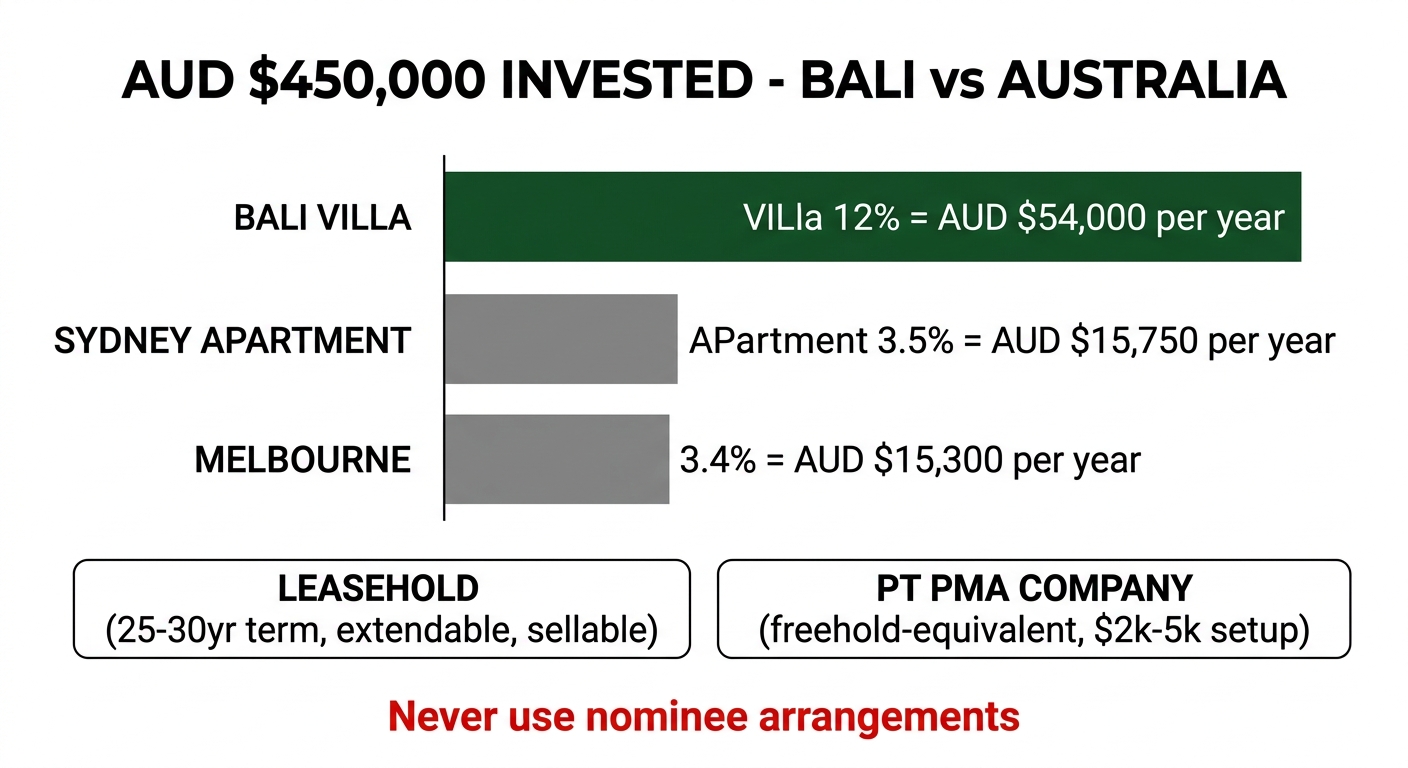
- ✓Leasehold is the most common route: 25–30 year terms, extendable to 50–80 years total, fully sellable, lower entry cost. Right for most first-time buyers.
- ✓Never use nominee arrangements: No legal standing in Indonesian courts. Zero protection if it breaks down. Stick to leasehold or PT PMA.
- ✓The yield gap is enormous: AUD $450,000 in a Bali villa at 12% gross = AUD $54,000/year. The same capital in a Sydney apartment at 3.5% = AUD $15,750/year.
- ✓Australian tax obligations apply: You must declare Bali rental income in Australia, but the Australia-Indonesia DTA means Indonesian tax paid is usually creditable against your Australian liability.
Can Australians Legally Own Property in Bali?
The short answer is yes, with the right structure. Indonesian law does not permit foreigners to hold freehold (Hak Milik) title on land or property. This is the same for all foreign nationals, not just Australians. However, there are two well-established, legally recognised pathways that Australian investors use every day. If you want the answer for your exact situation, run it through our free ownership checker, which asks four questions and tells you which structure applies.
Option 1: Leasehold (Hak Sewa)
The most common route for Australian buyers. A leasehold agreement gives you the right to use and rent out a property for a defined term, typically 25 to 30 years, with options to extend. Leasehold is:
- Fully legal and recognised under Indonesian law
- The preferred structure for investment villas and short-term rental properties
- Lower entry cost than freehold in comparable markets
- Extendable, meaning most agreements include renewal options for another 20 to 30 years
- Sellable: you can sell the remaining leasehold term at any point
The key to a strong leasehold is getting the notarised agreement right from day one. The lease must be registered with a notary (PPAT), clearly define renewal terms and conditions, and include protections against the landowner selling the underlying land during your lease period.
Option 2: PT PMA (Foreign-Owned Company)
A PT PMA is an Indonesian foreign investment company. Once established, it can hold freehold title (Hak Guna Bangunan) on property. This route gives you freehold-equivalent ownership and is commonly used by investors building a portfolio of properties. It involves higher setup costs (typically USD $3,000 to $8,000 to establish the entity) and ongoing compliance requirements, but gives you the strongest legal position for long-term investment.
Most Australian buyers starting with one or two properties begin with leasehold and later consider PT PMA as their portfolio grows.
What About Nominee Arrangements?
You may hear about “nominee” structures where a local Indonesian individual holds the land title on behalf of a foreign buyer. Ayla strongly advises against this. Nominee arrangements are not legally recognised in Indonesia and have no enforceability in Indonesian courts. If the arrangement breaks down, you have no legal recourse to recover your property or funds.
Stick to leasehold or PT PMA. Both are legitimate, widely used and fully enforceable.
How Much Does Property Cost for Australian Buyers?
Based on our 2026 analysis of 511 active listings across 80 developers and 15 Bali areas, the median entry price for a new-build or off-plan villa in Bali is USD $290,000 (approximately AUD $450,000 at current rates). This typically includes:
- A private villa with pool
- 25 to 30 year leasehold
- Fully furnished and rental-ready
Prime areas like Canggu and Seminyak command higher entry points (USD $350,000 to $600,000+), while emerging areas like Kedungu and East Bali offer strong opportunities from USD $180,000.
What Returns Can Australians Expect?
Rental yields across the island average 10.6% per annum based on our 2026 dataset, with well-managed villas in high-demand areas achieving 15%+ consistently. Compare this to Sydney or Melbourne where gross yields on residential property typically sit between 3% and 4%.
The investment case for Bali is compelling precisely because of this yield gap. An AUD $450,000 villa in Bali generating 12% gross yield returns AUD $54,000 per year. The same capital in a Sydney apartment might generate AUD $16,000. You can run this comparison for your own budget with our free Bali ROI calculator.
The Legal Process for Australian Buyers
Here is the typical buying process from start to finish:
Step 1: Due Diligence on the Property Before signing anything, a qualified Indonesian notary (PPAT) checks the land title, confirms there are no outstanding liens or disputes, and verifies the developer’s permits (IMB/PBG building permit, environmental clearance).
Step 2: Sign a Booking Agreement A small holding deposit (typically USD $2,000 to $5,000) secures the property while due diligence completes. This is refundable if due diligence reveals issues.
Step 3: Notarised Lease Agreement The full leasehold agreement is drawn up by the notary, translated into both English and Bahasa Indonesia, and signed by both parties. This is the critical document, the one that defines your ownership rights, renewal terms, and protections.
Step 4: Payment Most Bali developers offer staged payment plans: typically 30% to 40% on signing, with the remainder paid in instalments tied to construction milestones (for off-plan) or immediately (for ready villas).
Step 5: Registration The lease is registered with the National Land Agency (BPN). This public registration is what gives your ownership legal standing.
The whole process typically takes 4 to 8 weeks from first payment to signed and registered agreement.
Tax Considerations for Australians
Indonesian taxes you will pay:
- Land and Building Tax (PBB): approximately 0.5% of assessed value per year
- Rental income tax: 10% withholding tax on gross rental income if the property is managed through an agent
- Capital gains on sale: approximately 2.5% of gross sale proceeds
Australian tax obligations: Australian residents are taxed on worldwide income, including Bali rental income. You must declare rental income from your Bali property in your Australian tax return. You can generally claim deductions for property management fees, maintenance costs, and interest on any borrowings. Depreciation rules differ from Australian property, so speak to a tax accountant experienced in offshore property.
The Australia-Indonesia double tax agreement (DTA) means you generally receive a credit in Australia for taxes already paid in Indonesia, avoiding double taxation.
The Biggest Mistakes Australian Buyers Make
1. Skipping independent legal advice. Some developers offer to handle all the paperwork in-house. Always use your own independent Indonesian notary.
2. Choosing the wrong area for their goal. An area great for lifestyle enjoyment (Ubud) may not be the best for short-term rental yield (Canggu, Seminyak, Uluwatu). Get clear on your primary objective first.
3. Underestimating management costs. A well-managed Bali villa requires a local property manager. Budget 15% to 25% of gross rental income for management fees, plus ongoing maintenance.
4. Not checking developer track record. Our 2026 research across 80 Bali developers revealed significant variation in delivery timelines and build quality. Always verify a developer’s completed projects before committing.
Ready to Take the Next Step?
Ayla Property works exclusively with Australian, Singaporean and regional Asian investors entering the Bali market. We have direct relationships with the island’s most reputable developers, represent none of them, and negotiate on the buyer’s side. Our fee is paid by the developer on completion, never by you.
If you are considering buying property in Bali as an Australian, the best first step is a free 30-minute call to walk through your specific situation, budget and goals.
You may also find these resources useful:
- can foreigners buy property in Bali — complete legal guide
- Bali Developer Report 2026: our independent analysis of 511 listings across 80 developers
- Best Areas to Invest in Bali 2026: where we are telling clients to put their money right now
Considering investing in Bali? Let's talk. Book a no-obligation call.