1 June 2026
Is Buying Property in Bali a Good Investment? Real Data from 511 Listings
We analysed 511 active property listings across 80 Bali developers and 15 areas. Here is what the data actually says about yields, entry prices, and whether Bali property is worth it in 2026.
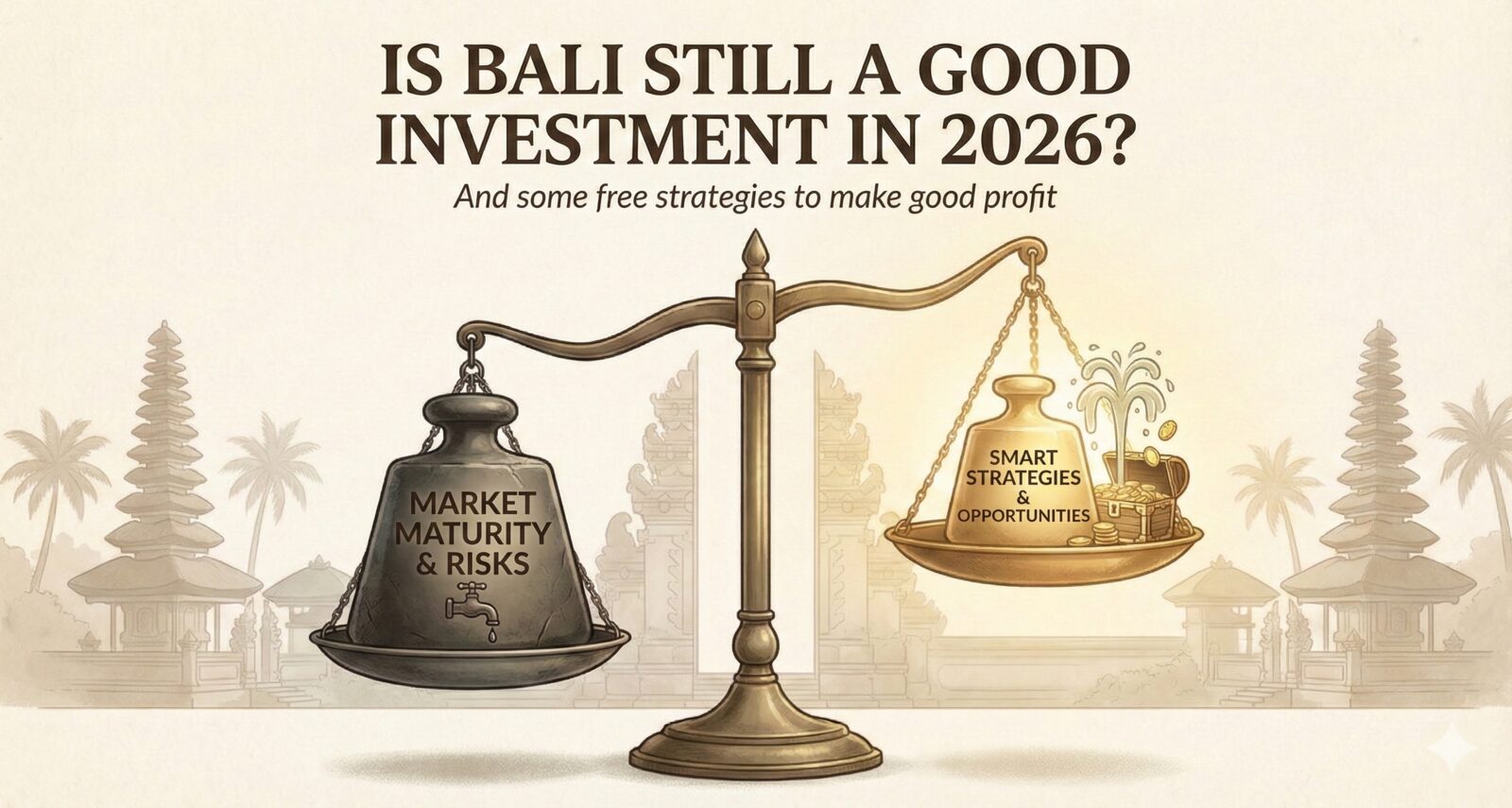
The question we get asked more than any other is this: Is buying property in Bali actually a good investment, or is it hype?
Most of what you read online is anecdotal: someone’s personal win, a developer’s marketing, or a forum post from someone who never actually bought. We wanted real data. So we built it ourselves.
In 2026, Ayla Property compiled the most comprehensive independent dataset of the Bali new-build and off-plan property market ever published: 511 active listings, 80 developers, 15 areas across the island. Here is what the numbers say.
The Headline Numbers
Before diving in, here is what our dataset shows at a glance:
| Metric | Figure |
|---|---|
| Listings analysed | 511 |
| Developers covered | 80+ |
| Areas tracked | 15 |
| Median entry price | USD $290,000 |
| Average gross rental yield | 10.6% |
| Top-performing area yield | 14.8% (Canggu) |
| Lowest entry price area | USD $165,000 (East Bali) |
The short answer: yes, Bali is a genuinely good investment in 2026, but the return is highly dependent on area, developer quality, and property management. The island average masks a wide spread.
Yield Comparison: Bali vs Other Markets
To put the 10.6% average yield in context, here is how Bali compares to the markets our clients typically come from:
| Market | Average Gross Rental Yield |
|---|---|
| Bali (our data, 2026) | 10.6% |
| Sydney residential | 3.2% |
| Melbourne residential | 3.4% |
| Singapore residential | 2.8% |
| Dubai (residential) | 6.5% |
| Gold Coast | 4.8% |
Bali is not marginally better. It is in a different category. Even at the lower end of our dataset, the worst-performing areas still delivered 7.2% gross yields. That is still double most Australian capital city returns.
Where the Best Returns Are
Our data shows a clear pattern: the highest yields come from areas with high tourist footfall and strong short-term rental demand. The lower yields come from lifestyle areas where buyers pay a premium for exclusivity.
Highest yielding areas (gross, 2026 data):
- Canggu: 14.8%, driven by digital nomad demand and year-round occupancy
- Seminyak: 13.1%, established luxury short-stay market
- Uluwatu / The Bukit: 12.4%, premium cliffside villas and high nightly rates
Strong mid-tier areas:
- Ubud: 9.6%, cultural tourism with strong occupancy but lower nightly rates
- Sanur: 8.9%, family market with longer-stay guests and lower management intensity
- Kedungu: 11.2%, emerging area where supply is still tight relative to demand
Important caveat: these are gross yields. Net yields after management fees (typically 15% to 25% of gross), maintenance, and tax run approximately 20% to 30% below gross. A 14.8% gross yield in Canggu translates to roughly 10% to 12% net, which is still exceptional by any global benchmark.
What Does Entry Price Buy You?
At the median price of USD $290,000 (approximately AUD $450,000), a typical purchase delivers:
- A private villa with 2 to 3 bedrooms and a private pool
- Fully furnished and styled to short-term rental standard
- 25 to 30 year leasehold with renewal options
- A property management setup ready to list on Airbnb and Booking.com from day one
For context, USD $290,000 in Sydney buys a studio apartment with no pool. In Bali it buys a full villa operation.
The lowest entry in our dataset is USD $165,000 in East Bali for a two-bedroom villa with shared pool facilities. The highest is USD $2.1 million for a clifftop estate in Uluwatu. The majority of international investor activity sits between USD $200,000 and $500,000.
The Risks, And How Real They Are
Any honest investment analysis has to cover the downside. Here are the real risks in the Bali property market and how significant each is in practice:
Developer delivery risk. Off-plan properties are bought before they are built. Some developers deliver late; a small number do not deliver at all. This is the single biggest risk in the Bali market. Our research identified significant quality variation across the 80 developers in our dataset, which is exactly why independent developer due diligence matters. Ayla only works with developers with a verified delivery track record.
Leasehold risk. You do not own the land freehold. If your lease is not properly structured, you have limited legal protection if the landowner disputes the arrangement. Solved by using a qualified Indonesian notary and ensuring the lease is publicly registered with the BPN.
Currency risk. Your rental income is in IDR (Indonesian Rupiah). If the IDR weakens against AUD or SGD, your effective yield in home currency falls. The IDR has been broadly stable against AUD over the past five years but this is a real consideration for long-term hold strategies.
Regulatory risk. Indonesian property law applies to foreigners and does change. The fundamental leasehold and PT PMA structures have been in place for decades and show no signs of changing, but any regulatory environment can shift.
Management dependency. A Bali villa without good local management can see occupancy rates fall sharply. This is not unique to Bali. Any short-term rental investment is management-dependent, but the physical distance from most buyers makes it more acute.
The Investment Case in Plain Terms
If you invest USD $290,000 in a Canggu villa at 14.8% gross yield, the rough maths over a 10-year hold look like this:
- Gross rental income (Year 1): USD $42,900
- Net rental income after costs (~25% deduction): USD $32,200
- Cumulative net income over 10 years (modest 3% annual growth): approximately USD $370,000
- Capital appreciation on the villa: typically 8% to 15% over the leasehold period in established areas
- Net position: you have returned your full capital from rental income alone, plus retained the remaining 15 to 20 years of leasehold to sell
This is not a speculative play. It is a cash-flow-positive asset from year one, with leasehold resale value on top. If you want to model these numbers against your own budget and target area, our free Bali ROI calculator uses the same dataset.
What Our Data Cannot Tell You
No dataset answers everything. Our analysis covers listed prices and projected yields, not actual achieved occupancy or management outcomes. The difference between a 60% and 85% occupancy rate on the same villa is roughly 40% of your annual income. Property management quality is the variable that determines whether you hit the top or bottom of the yield range.
We also cannot predict regulatory changes, currency moves, or macroeconomic shocks. What we can say is that Bali has absorbed multiple external shocks over the past 20 years: the 2008 financial crisis, COVID-19, various regional disruptions. In each case the property market recovered and continued to grow.
Download the Full Dataset
The complete Bali Property Market Report 2026, including area-by-area price breakdowns, ROI tables, developer pipeline data, and our full methodology, is available free to download.
New to the Bali market? Start with our complete guide to buying property in Bali as a foreigner. If you would like to talk through what these numbers mean for your specific situation, a free 30-minute call with Ayla is the best starting point. If you are still at the stage of working out what you are legally allowed to buy, start with our free ownership checker instead.
Considering investing in Bali? Let's talk. Book a no-obligation call.