
2 June 2026
Moving to Bali from Australia: 2026 Buying & Property Guide
Thousands of Australians move to Bali every year. Here is why buying property makes more financial sense than renting long term, and exactly how to do it.
Australians are the largest single group of foreign buyers I work with in Bali, by a significant margin. That is not a coincidence. The geographic proximity, direct flights from every major Australian city, and a shared cultural comfort with the island all play a role. But increasingly, the driver is financial. Moving to Bali from Australia has gone from a lifestyle choice to a genuinely smart economic decision, and the numbers explain why.
📌 Moving from Australia to Bali: 2026 Executive Summary
- The Rent vs Buy Reality: Renting a quality 2 to 3 bedroom villa in expat hubs like Canggu or Pererenan costs $24,000 to $36,000 USD per year in dead capital. Purchasing a leasehold villa has a current median entry point of $290,000 USD, shifting an ongoing expense into an equity-retaining asset.
- The Passive Income Play: Bali’s tourism demand allows Australian expats to generate significant cash flow. Canggu commands a 14.8% average gross yield when units are placed on the short-term rental market during visits back to Australia, making it highly viable to offset ownership costs entirely.
- Residency and Visa Compliance: Clean legal pathways such as the Golden Visa (E28C) provide stable long-term residency. These visas are designed for remote workers earning offshore income and strictly prohibit taking local Indonesian employment without a PT PMA structure.
- Tax and Income Guardrails: Remote workers earning AUD from Australian companies face a seamless transition. Under the Australia-Indonesia Double Tax Agreement, Indonesian withholding taxes paid can generally be credited against Australian tax liabilities, avoiding double taxation.
- Lifestyle Arbitrage: Local staff, dining, gyms, and daily living costs run at a fraction of coastal Australian prices. Imported goods, electronics, and Australian-sourced products carry a premium, so the lifestyle saving is greatest for those who adapt to what Bali does well.
The Scale of Australian Migration to Bali
Indonesian immigration data consistently shows Australians as one of the top nationalities taking longer-term stay visas in Bali. The shift accelerated post-2020 as remote work normalised and Australians realised they could earn in AUD while living in a place where that income goes three to four times as far.
Today the Australian community in Bali is substantial and established. There are Australian schools, a strong expat support network, direct Qantas and Jetstar connections from Sydney and Melbourne, and BIMC Hospital in Kuta is staffed with English-speaking doctors accustomed to treating Western patients. The infrastructure for Australians is there. The question is whether you rent or buy once you decide to stay.
The Rent vs Buy Maths
Let me be direct about what renting costs long term in the areas where most Australians want to live.
A quality villa in Canggu, two to three bedrooms, pool, reasonable finishes, runs $2,000 to $3,000 per month on a long-term lease. In Pererenan that figure is slightly lower. In Seminyak it is higher. Across the areas most popular with Australian expats, you are looking at $24,000 to $36,000 per year in rent, with no asset at the end of it.
Over five years, that is $120,000 to $180,000 gone. The landlord benefits. You get nothing back.
Now consider buying. A leasehold villa in the same neighbourhoods, same quality, entry-level investment grade, is available from around $290,000, which is the current median across our 511 listings. You put down the purchase price, take a 25 to 30 year lease with a renewal clause, and you now own the right to occupy and rent the property for decades.
The numbers make the case more clearly in a table:
| Financial Metric | Renting a 2 to 3 Bed Villa (Canggu) | Buying a Median Leasehold Villa |
|---|---|---|
| Annual Cost | $24,000 to $36,000 (lost capital) | $290,000 (asset acquisition) |
| 5-Year Total | $120,000 to $180,000 spent | Equity retained in leasehold |
| Passive Cash Flow | 0% (pure expense) | 14.8% average gross yield when renting out |
| Asset at End of Term | None | Realisable secondary market resale value |
The practical upside is significant. When you are travelling or back in Australia visiting family, you put the property on the short-term rental market. In Canggu, average gross yields are running at 14.8% across current data. On a $300,000 villa, that is $44,400 per year in gross rental income at full commercial occupancy. Even at 60% occupancy during your absent months, you are generating $15,000 to $20,000 per year that offsets your cost of ownership entirely. Model your own budget with our free Bali ROI calculator.
You are not just saving rent. You are generating income. That is the real difference between renting and owning in Bali.
The Visa Advantage of Owning
This is a point most guides miss. Australians who invest at the right level unlock two meaningful long-stay visa pathways that remove the visa-run cycle entirely.
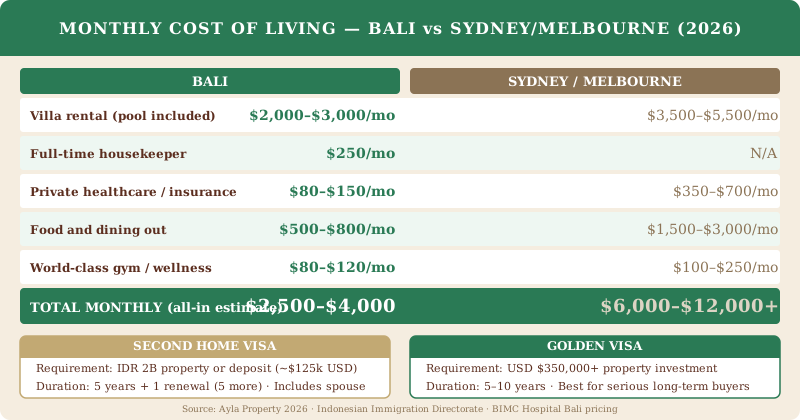
The Golden Visa (E28C) is the most relevant for property investors. It offers 5-year renewable residency for individuals who invest at least USD $350,000 in qualifying instruments, or 10-year residency for investments of USD $700,000 or above. There is also a property-specific route at the 10-year tier for residential apartment purchases of USD $1,000,000 or above. This visa covers a spouse and dependents.
The Investor KITAS is the other pathway, typically used when the investment is structured through a PT PMA company. It requires the company to meet its investment plan obligations and is the route to take if you are also planning to operate a commercial rental business.
One compliance point that is critical for remote workers: both of these residency pathways strictly prohibit earning local Indonesian income or taking local employment. They are designed precisely for Australians earning remotely in AUD from Australian companies, which is the profile of most buyers I work with. If you want to work locally, employ local staff directly, or run a business that earns Indonesian income, you need a PT PMA structure and the appropriate commercial permits. The residency visa alone does not cover this.
For most Australian remote workers and investors, the Golden Visa or Investor KITAS gives you legal, stable long-term residency without the administrative burden of constant visa renewals.
Can Australians Actually Buy Property in Bali?
Yes. I get this question constantly. Australians, like all foreign nationals, can legally purchase leasehold property in Bali. There is no nationality restriction. The mechanism is a notarised leasehold agreement (Hak Sewa) executed before a licensed Indonesian notary.
You do not need to be physically present in Indonesia to complete the purchase. You can grant power of attorney to your legal representative in Bali and complete the entire transaction remotely. I have processed fully remote purchases for Australian clients who never left Sydney. The due diligence, legal review, notarisation, and payment can all be handled with the right team on the ground.
The short answer to the legal question is yes, and it is more straightforward than most Australians expect. You can read the full legal breakdown in our guide to foreigners buying property in Bali.
The Areas That Suit Australian Expat Life Best
Not every part of Bali works the same way for Australian buyers. Here is an honest take on the three areas that consistently attract Aussie expats.
Canggu remains the centre of gravity for younger Australians and remote workers. Strong café culture, good gyms and surf, active social scene, and a large Australian community. Property prices reflect the demand, with entry around $350,000 to $380,000 for a quality investment villa, but yields justify the price at 14.8% gross average. Explore property in Canggu.
Pererenan is where a lot of Canggu overflow has landed in the last two years. It is quieter, slightly cheaper, and still close enough to Canggu’s amenities to matter. For buyers who want the same vibe with 15 to 20% off the entry price, this is the area worth looking at closely. View available villas in Pererenan.
Sanur is a different character entirely. It is more settled, more family-oriented, with a long-standing Australian expat community that has been there for decades. Villa prices are lower than Canggu, yields are more moderate, and it suits buyers who want a quieter pace of life without sacrificing connection to the broader expat community. See what is available in Sanur.
The Lifestyle Reality
I want to be clear about the lifestyle side too, because it matters to the financial decision. The cost of living in Bali is genuinely lower than coastal Australia, but not in every category.
Staff costs are very low by Australian standards. A housekeeper runs $200 to $300 per month. A driver, if you want one, is similar. A private chef is affordable in a way that makes no sense from an Australian frame of reference.
Food is cheap at local warungs and still reasonable at the mid-range international restaurants popular with expats. Gyms are good and inexpensive. Healthcare at private hospitals is a fraction of Australian costs for most procedures.
On the other hand, imported goods, certain electronics, good wine, and anything from Australia specifically costs more here than at home. The lifestyle is genuinely affordable if you lean into what Bali does well. It gets more expensive if you try to replicate an Australian shopping and consumption pattern.
For Australians thinking seriously about buying, the next step is understanding the process and what due diligence looks like. Our property investment guide covers the full framework, and I am always available for a direct conversation about whether a specific property or area makes sense for your situation.
You can also check which ownership structure applies to you as an Australian buyer with our free ownership checker, which takes about thirty seconds.
Book a 30-minute call here: calendly.com/ayla-teamoperations/30min. No obligation, no pitch. If it is not the right move, I will tell you that too.
Considering investing in Bali? Let's talk. Book a no-obligation call.